The money doesn’t vanish, and the bank doesn’t get to keep it. That’s the first thing worth saying, because a lot of families quietly assume the worst.
When someone dies, their balance stays exactly where it was. What changes is who can get it out and how much paperwork that takes. The answer depends on three things: whether the account had a nominee, whether it was a joint account, and how much money is involved.
The rules got a lot clearer recently. RBI’s Settlement of Claims in respect of Deceased Customers of Banks Directions, 2025 replaced the different practices banks used to follow with one standard framework and standard documentation, and all commercial and cooperative banks had to implement it by March 31, 2026. So if you went through this with a relative five years ago and it was a nightmare, it should be easier now. Not effortless, but easier.
What happens immediately after the account holder dies?
Nothing happens on its own. The bank doesn’t know about the death until someone tells it.
Once a family member informs the branch, usually with a copy of the death certificate, the bank marks the account as deceased and stops normal operations. No more withdrawals, no more debit card use, no more UPI. Money already in the account stays there and keeps earning interest until the claim is settled.
It’s better to inform the bank early than to wait. Delay doesn’t protect the money. It only leaves room for mistakes and for auto-debits to keep running.
What if the bank account has a nominee?
This is the easy case, and it’s the whole reason nomination exists.
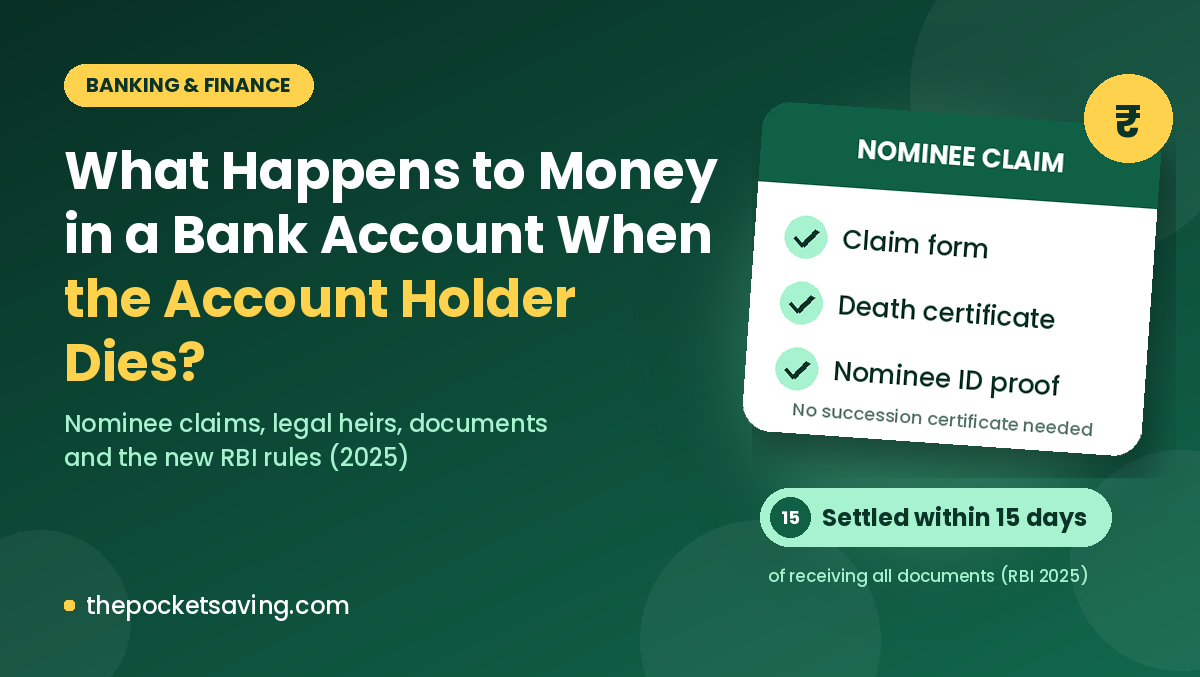
When there’s a valid nominee, the bank can’t make the family run around for court papers. The bank cannot insist on legal documents such as a Succession Certificate, Letter of Administration or Probate of Will, or ask for an indemnity bond or surety, no matter how much money is in the account. The nominee needs three things: a claim form signed by the nominee, the death certificate of the account holder, and an officially valid document proving the nominee’s identity and address.
That’s it. Three documents.
There’s one newer detail worth knowing. Since November 2025, one nominee isn’t the limit anymore. Under the Banking Laws (Amendment) Act, 2025, depositors can name up to four nominees and specify a percentage share for each, as long as the total is 100 percent. Or they can list up to four nominees in order of priority, where the next person becomes operative only if the previous one has died. For lockers, the rule is stricter, and only successive nominations are allowed.
Let’s understand with an example:
Let’s say Rajesh has ₹6 lakh in his savings account.
A few years ago, when he opened the account, he added his wife, Neha, as the nominee.
Rajesh dies.
What happens now?
Neha can approach the bank and submit the required documents, including proof of Rajesh’s death and her identity. The bank will verify the details and process the claim according to its procedure.
Having a nominee generally makes this process much easier.
But there is one important point that many people misunderstand.
A nominee and a legal heir are not necessarily the same thing
Just because someone is your nominee doesn’t automatically mean that person becomes the final owner of all the money under succession law.
RBI guidance explains that when a bank pays the amount to a nominee, the nominee receives it as a trustee for the legal heirs. In other words, the bank can discharge its liability by paying the nominee, while questions about the ultimate rights of the heirs can still remain.
So, if you have nominated your spouse, child, parent or another person, don’t assume that nomination alone settles every inheritance question.
That’s why nomination and proper estate planning are both important.
Does the nominee become the owner of the money?
No. This is the part most people get wrong, and it causes real family fights.
A nominee is the person the bank pays. The bank’s job ends there. Who actually owns the money is decided by the will, or if there’s no will, by succession law. Those are two separate questions.
RBI now requires banks to say this in writing. When paying a nominee, the bank must make clear that they are receiving the money as a trustee of the deceased’s legal heirs, and that the payment does not affect any claim other people may have against the nominee for that amount.
So if a father names his elder son as nominee but his will splits everything equally among three children, the elder son collects the money from the bank and then holds it for all three. He can’t keep it just because his name was on the form. The Supreme Court made the same point in 2023 in a case about shares (Shakti Yezdani v. Jayanand Salgaonkar): a nominee is not automatically the owner.
A nominee is a convenience, not an inheritance.
What happens if there is no nominee?
Then the legal heirs have to claim the money, and the paperwork depends on the amount.
For smaller balances, RBI requires a simplified procedure. The cutoff, called the threshold limit, is ₹5 lakh for co-operative banks and ₹15 lakh for other banks, or a higher limit if the bank chooses. The simplified route applies only if there’s no nomination, no will, no contesting claim, and no court order stopping the payment.
Below the threshold, heirs generally submit:
- The claim form, signed by the claiming heirs
- Death certificate
- ID and address proof of each claimant
- An indemnity bond
- A no-objection letter from any heir who isn’t claiming
- A Legal Heir Certificate, or a declaration about who the heirs are from an independent person who knows the family and isn’t part of the claim
No third-party surety can be demanded at this level. That used to be a real headache, since families had to find someone “good for the amount” to sign.
Above the threshold, it gets heavier. The bank can accept a Succession Certificate, or a Legal Heir Certificate or notarised affidavit along with the other documents. In the second case, the bank may also ask for a surety bond from third parties it accepts, which can include non-claimant legal heirs.
If there’s a will, the bank normally wants probate or a Letter of Administration. It can use its discretion and act on the will without probate if there’s no dispute among heirs or beneficiaries and it’s satisfied the will is genuine. If the family is fighting, expect court documents. There’s no shortcut around a dispute.
What happens with a joint bank account?
It depends on how the account was opened. Look at the account opening form or the passbook for words like “Either or Survivor” or “Former or Survivor.”
If the account has a survivorship clause, the surviving holder usually just keeps operating it, or closes it, after submitting the death certificate. RBI treats survivors much like nominees here. Payment to them is a valid discharge for the bank, and they also receive it as trustees for the legal heirs.
If the joint account required both signatures and had no survivorship clause, the survivor can’t act alone. The deceased holder’s legal heirs have to join in.
One thing surprises people. In a joint account, the nominee’s right arises only after all the account holders have died. So if a husband and wife hold a joint account with their daughter as nominee, and the husband dies, the daughter has no claim yet. The wife continues as survivor.
Documents generally required to claim the balance
Here’s the checklist in one place. Your bank may add small things, but this is the core.
Nominee or survivor: claim form, death certificate, ID and address proof.
Legal heir, no nominee, amount below threshold: claim form, death certificate, ID proof of claimants, indemnity bond, no-objection letters from other heirs, and a Legal Heir Certificate or an independent declaration.
Legal heir, amount above threshold: the above plus a Succession Certificate, or a Legal Heir Certificate or notarised affidavit, and possibly a surety bond.
Will involved: probate or Letter of Administration, unless the bank uses its discretion.
The forms are standard now. Banks must keep them in every branch and on their website, and must publish the list of documents and procedure for different scenarios. You can also lodge a claim at any branch of the bank, not only the home branch. If you submit something incomplete, the bank has to tell you what’s missing when it acknowledges your claim. Ask for that acknowledgment in writing. It matters later.
One exception: PPF and Senior Citizen Savings Scheme accounts follow their own scheme rules, not these RBI directions, so ask the bank for the separate claim form.
Does the bank require a succession certificate?
Usually not.
With a nominee or survivor, never. With no nominee and a balance under ₹15 lakh (₹5 lakh at a co-op bank), no. Above that threshold, a Succession Certificate is one option, but a Legal Heir Certificate or affidavit route is also allowed.
If a branch officer insists on a succession certificate for a nominated account, they’re going against RBI’s directions. Politely point that out, and escalate to the branch manager if needed.
What happens to FDs linked to the deceased person’s account?
Fixed deposits follow the same claim process as the savings account, and the same nominee rules.
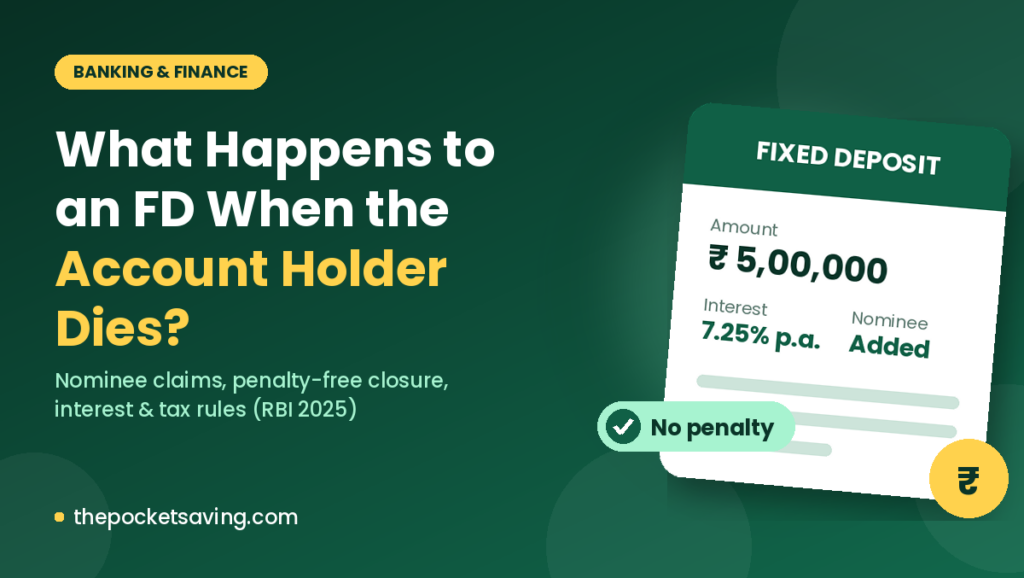
The good news: there’s no penalty for breaking them early. Banks must include a clause in the account opening form allowing premature closure of term deposits without any penalty on the depositor’s death, even during a lock-in period.
Joint FDs are trickier. Breaking one early needs consent from the surviving depositors and the legal heirs of the deceased holder, unless all holders had given the bank a joint mandate allowing survivors to withdraw early. Most people never give that mandate, so check.
If the FD simply matures during the claim process, it sits there until someone claims it.
Families that spread FDs across several banks to chase better rates, like the ones in our list of banks offering 8% or higher interest on fixed deposits, should know that each bank needs its own claim. A simple list of where every FD sits saves your family a lot of searching later.
What happens to auto-debits, EMIs and standing instructions?
Once the bank marks the account deceased, most standing instructions stop. SIPs, insurance premiums, subscriptions and ECS mandates will start bouncing.
That’s mostly fine, but a few things need attention:
Loan EMIs don’t disappear. Any loan the person had is still a debt of their estate. Check whether the loan had insurance attached, because many home and personal loans do, and the insurer may pay it off. Contact the lender directly rather than just letting EMIs bounce.
Insurance premiums. If the deceased was paying a premium for someone else’s policy, that policy may lapse. Tell the family member it covers.
Money coming in. Pension, rent, dividends or refunds may keep landing. After the claim is settled, any new credit in the deceased’s name is returned to the sender marked “Account holder deceased”, and the nominee, survivor or legal heirs are informed. Update pension offices, tenants and the like so money isn’t bouncing around for months.
What happens if nobody claims the money for years?
The money still isn’t lost.
If there’s no customer-initiated transaction for two years, the account becomes inoperative. After ten years, it’s classified as unclaimed. Savings and current account balances not operated for 10 years, or term deposits not claimed within 10 years of maturity, are transferred by banks to the RBI’s Depositor Education and Awareness (DEA) Fund.
The transfer is an accounting move, not a confiscation. Banks transfer the entire amount, including accrued interest as on the transfer date. The heir can still claim it from the bank, and the bank recovers it from the fund.
The amount sitting in there is huge. One estimate put it at ₹72,454 crore in the DEA Fund as of 28 January 2026. A good chunk of that belongs to people who died without telling anyone about an old account.
How to find unclaimed deposits
RBI runs a free portal called UDGAM where registered users can search for unclaimed deposits across multiple banks in one place. Coverage has grown a lot. RBI told the Supreme Court in May 2026 that 30 major banks representing 90 percent of unclaimed funds are now on the platform.
Two things to know before you start. First, UDGAM only finds the deposit. It doesn’t settle or release money. You still claim it from the bank. Second, it only shows deposits already moved to the DEA Fund. If the account is dormant but under ten years old, it won’t show up. Search the bank’s own unclaimed-deposit list on its website or ask the branch.
If you remember a parent mentioning “an old account in the village” or at a bank that merged years ago, it’s worth an evening on UDGAM.
Practical steps families should take
This order tends to work:
- Get several certified copies of the death certificate. Every bank, insurer and office will want one.
- Collect passbooks, cheque books, FD receipts and old bank SMS or emails. These tell you which banks to approach.
- Inform each bank in writing. Keep the acknowledgment.
- Find out if there’s a nominee, survivorship clause or will for each account.
- Stop using the ATM card, net banking and UPI immediately, even if you know the PIN.
- Download the claim form from the bank’s website and submit the full document set in one go.
- Keep track of the date the bank confirms your documents are complete. The 15-day clock starts there.
- Search UDGAM for older accounts.
On the deadline: banks must settle deposit claims within 15 calendar days of receiving all required documents. If the delay is the bank’s fault, it has to explain why and pay interest of at least Bank Rate plus 4 percent per year on the amount for the delay period. If a bank sits on a complete claim, you can file a complaint with the RBI Ombudsman online.
How you can make things easier for your own family
Most of the pain above is avoidable. It takes about twenty minutes per bank.
Add nominees to every account and FD. Most banks let you do it in net banking now. Use the new multi-nominee option if you want the money split.
Don’t forget your shares. Bank nomination doesn’t cover your investments. Shares and mutual funds held in a Demat account have their own nomination, which you update with your broker or depository.
Make your nomination match your will. If they point in different directions, you’re setting up a fight. The nominee collects, the will decides, and the family has to sort out the gap.
Write a simple list. Bank names, branches, account types, FD details, loans, lockers. Put it somewhere a trusted person knows about. It doesn’t need to include passwords.
Close accounts you don’t use. Every forgotten account is one more claim your family has to find and file.
Consider joint accounts with a survivorship clause for the main household account, so the spouse isn’t locked out of money for groceries during the worst weeks. Keeping an emergency fund that the surviving family can reach helps for the same reason.
Write a simple list. Bank names, branches, account types, FD details, loans, lockers. Put it somewhere a trusted person knows about. It doesn’t need to include passwords. If you already track your money with a monthly budget, add this list to the same file.
None of this is morbid. It’s just tidy.
What is the RBI UDGAM portal?
If you’re trying to find an old or forgotten bank deposit, the RBI’s UDGAM (Unclaimed Deposits – Gateway to Access Information) portal can be useful.
It was created to help people search for unclaimed deposits held with participating banks.
So, if your parents or another family member have passed away and you suspect they may have had an old bank account or deposit that nobody knows about, UDGAM is one place worth checking.
You will still need to approach the concerned bank to complete the actual claim process.
FAQs
Yes. The bank will pay the full balance to the nominee, or split it by the share percentages if there are several simultaneous nominees. But the nominee holds that money for the legal heirs and may have to share it according to the will or succession law.
Not from the bank directly. The bank pays the nominee. A legal heir who believes they’re entitled to a share then claims it from the nominee, through a family settlement or through court if it comes to that.
No. Once the account holder dies, nobody has authority to operate the account, even with the PIN. Withdrawing money this way can create legal trouble for the person doing it and messes up the claim process for everyone else. Inform the bank and go through the claim.
RBI’s limit is 15 calendar days from the date the bank has all required documents. In practice, the time goes into collecting documents, especially a Legal Heir Certificate, which can take weeks depending on your state.
All of them are part of the claim. Heirs who don’t want to claim sign a no-objection letter, and the rest sign the claim form. If they can’t agree, the bank will want a succession certificate or court order before paying anyone.
If there were successive nominees, the next person in line steps in. With only one nominee who died before the account holder, the account is usually treated as having no nominee, and the legal heirs of the account holder claim it. If the nominee died after the account holder but before collecting, check with the bank. This is an edge case where legal advice is worth it.
Yes, in effect. Once informed, the bank stops operations on a sole account until the claim is settled. Interest keeps accruing. For a joint account with a survivorship clause, the survivor can usually keep operating it.