When a parent or spouse dies, their fixed deposits are often the biggest pile of money the family has to deal with. They’re also the most confusing part. Does the FD break automatically? Will the bank cut a penalty? Does interest stop? Who pays tax on it?
Here’s the short answer. The FD doesn’t disappear and doesn’t break on its own. It keeps earning interest until someone claims it. The nominee, surviving joint holder, or legal heirs can either close it early without any penalty or let it run until maturity.
The details depend on how the FD was set up, and that’s what this guide walks through.
Quick answer: what happens to an FD after death
- The FD stays with the bank and continues to earn interest.
- The nominee, survivor or legal heirs can close it early without paying any penalty, even during a lock-in period.
- They can also choose to keep it until maturity.
- With a nominee, the claim needs only three documents.
- Without a nominee, legal heirs claim it through the bank’s process. The paperwork is simpler for amounts up to ₹15 lakh.
- Interest earned up to the date of death goes in the deceased person’s final tax return. Interest after that is taxed as the heir’s income.
The rules changed recently
Until a year ago, every bank handled deceased depositors in its own way. That changed when RBI notified the “Settlement of Claims in respect of Deceased Customers of Banks” Directions, 2025, on 26 September 2025, and all commercial and co-operative banks had to put them in place by 31 March 2026.
So if you dealt with a bank after a death a few years ago and it was painful, the process should be noticeably smoother now. The rules below are the ones in force today.
What happens right after the depositor dies?
Nothing happens automatically. The bank only acts once a family member informs it, usually by submitting a copy of the death certificate.
Until then, the FD simply continues. Interest keeps accruing at the contracted rate. If the FD was set to pay interest monthly or quarterly into a savings account, those payouts will keep landing in that account, which will itself be frozen once the bank learns of the death.
It’s best to inform the bank early, even if you’re not ready to claim the money yet. It stops any confusion with auto-renewals and payouts.
Option 1: Close the FD early without a penalty
Normally, breaking an FD before maturity costs you, usually 0.5% to 1% less interest. Death is an exception.
Under RBI’s rules, banks now have to put a clause in the account opening form itself saying that if the depositor dies, the term deposit can be closed early without any penal charge, even if it’s within the lock-in period.
The interest is worked out for the time the FD actually ran. If the claim is made before maturity, the bank pays interest at the rate applicable to the period the deposit stayed with it, with no penalty.
So if your father had a 5-year FD and passed away after 2 years, the family would get interest at the bank’s 2-year rate (as it was when he opened the FD), with nothing deducted as a penalty.
Splitting is allowed too. If several heirs want to divide one large FD into smaller ones, RBI’s rules say no premature withdrawal penalty applies to the split, as long as the total amount and the period stay the same. This helps when siblings want to share an FD without breaking it.
Option 2: Keep the FD until maturity
Closing early isn’t always the best move. If the FD was booked when rates were high, it may be worth more to let it run.
Check today’s FD rates before deciding. If the old FD earns 7.5% and the same bank offers 6.5% today, keeping it until maturity makes more sense. If rates have gone up since then, closing early and reinvesting may be better.
Once the FD matures, the heirs claim the full maturity amount.
What if the FD has a nominee?
This is the simplest situation.
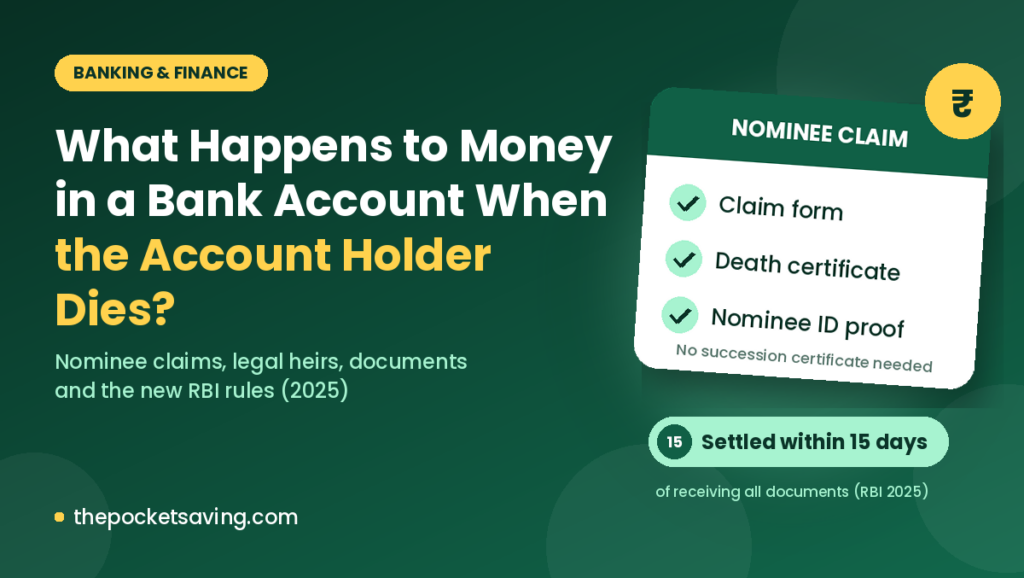
The nominee needs a claim form, the death certificate and their own ID and address proof. The bank cannot ask for a succession certificate, indemnity bond or surety, however large the FD is.
One point that families often get wrong: the nominee is not the owner. RBI’s directions make clear that a nominee is not the ultimate owner of the deceased’s money. They receive it on behalf of the legal heirs. If the will or succession law says the money should be shared among three children, the nominee has to share it, even though the bank paid it all to them.
Since November 2025, depositors can name up to four nominees, either with fixed percentage shares or in order of priority.
What if there is no nominee?
Then the legal heirs claim the FD, and the documents depend on the total amount the deceased held at that bank.
For smaller amounts, up to ₹15 lakh at commercial banks or ₹5 lakh at co-operative banks, the bank follows a simplified process. Heirs submit a claim form, the death certificate, their ID proofs, an indemnity bond, no-objection letters from other heirs, and either a legal heir certificate or a declaration from an independent person who knows the family.
Above that limit, the bank may ask for a succession certificate. But even there, banks can accept affidavits from independent persons in appropriate cases, which keeps the process reasonable.
If there’s a will, the bank usually asks for probate unless there’s no dispute among the heirs.
What happens to a joint FD?
It depends on the operating instruction on the FD.
Either or Survivor / Former or Survivor: The survivor can keep the FD and collect it at maturity. If the first holder dies before the FD matures, the survivor can withdraw the deposit when it matures.
Closing a joint FD early is where people get stuck. If one holder dies, closing the FD early needs consent from both the surviving holder and the legal heirs of the person who died. That can mean chasing siblings or in-laws for signatures.
There’s a simple way around this. Joint holders can give the bank a mandate allowing premature withdrawal under “Either or Survivor” or “Former or Survivor”, either when opening the FD or anytime during its term. With that mandate on file, the survivor can close the FD early without needing the heirs’ agreement.
If you have joint FDs, ask your bank for this mandate form now. We explain the different joint account modes in detail in our guide to whether a joint bank account is the best option for your spouse.
What interest does the family get?
That depends on when the claim is made.
If you Claimed at maturity: The family gets the full interest at the rate the FD was originally booked at, for the whole term. Nothing changes.
Closed before maturity: Here, the bank pays interest at its rate for the period the FD actually ran, and doesn’t cut any penalty. A 5-year FD closed after 2 years earns the 2-year rate that applied when it was opened.
Left unclaimed after it matures: This is where families quietly lose money. Once a matured FD sits unclaimed, it stops earning the FD rate. For the overdue period, the bank pays interest according to its own policy, and RBI’s rule for unpaid matured deposits is that they earn the savings account rate or the FD’s contracted rate, whichever is lower.
Savings rates are much lower than FD rates, so don’t let a matured FD sit for months while paperwork drags on. If the claim will take time, start it as early as you can.
Tax-saver FDs and lock-in periods
5-year tax-saver FDs normally can’t be broken early at all. Death is the exception. The RBI rule allows penalty-free premature closure after the depositor’s death even within the lock-in period, so the family isn’t forced to wait out the full five years.
Who pays tax on FD interest after death?
The interest is split into two parts at the date of death.
Interest up to the date of death belongs to the deceased. It’s reported in their final income tax return, filed under their PAN. Income earned from 1 April up to the date of death is taxable in the hands of the deceased, and the legal representative files that return using the deceased’s PAN. To do this, the heir first registers as the legal heir on the income tax e-filing portal, with the death certificate and proof of being the heir.
Interest after the date of death is the heir’s income. Interest that accrues after death is taxed in the hands of the legal heir or the estate. The heir adds it to their own income under “income from other sources” and pays tax at their own slab rate.
The FD amount itself isn’t taxed when you inherit it. Only the interest it earns after it comes to you is taxable.
A practical tip: banks often keep deducting TDS against the deceased’s PAN for a while after death. If TDS is deducted after the death, you can claim it in your own ITR. Keep the bank’s interest certificate for both periods.
What if there was a loan against the FD?
Many people take a loan or overdraft against their FD. If the depositor dies with that loan still outstanding, the bank will generally adjust the loan against the FD before paying the balance to the nominee or heirs. Ask the bank for a statement showing the loan balance, so you know what the final payout will be.
Documents and timeline
The documents are the same as for any deceased depositor’s claim: the claim form, the death certificate, the claimant’s ID proof, and, where there’s no nominee, the extra legal heir documents described above. Banks must keep standard claim forms at every branch and on their website.
Once the bank has all the documents, it has to settle the claim within 15 days. If it delays, it must pay compensation.
You can read RBI’s full rules in the Settlement of Claims in respect of Deceased Customers of Banks Directions, 2025. For savings accounts, auto-debits and the full claim process, see our guide on what happens to money in a bank account when the account holder dies.
What if nobody claims the FD?
This happens more often than you’d think, usually because the family didn’t know the FD existed.
If a matured FD isn’t claimed for 10 years, the bank transfers it to RBI’s Depositor Education and Awareness (DEA) Fund. The money isn’t lost, and heirs can still claim it from the bank afterwards.
To search for FDs your family may have forgotten, use RBI’s free UDGAM portal. It lets you search unclaimed deposits across many banks at once. It only shows deposits that have already gone to the DEA Fund, though, so for newer FDs, check the bank’s own records or old passbooks and statements.
Step-by-step: what the family should do
- Collect all FD receipts, e-receipts, bank statements and emails. These tell you which banks to approach.
- Inform each bank in writing and attach a copy of the death certificate.
- Check each FD for a nominee or a joint holder.
- Decide whether to close each FD early or keep it until maturity, based on its rate.
- Submit the complete claim documents together, so the 15-day clock starts.
- Register as legal heir on the income tax portal if the deceased needs a final ITR filed.
- Keep the bank’s interest certificates for the period before and after death.
How to make this easier for your own family
Most of the trouble above comes from a few missing details. You can fix them in an afternoon.
Add a nominee to every FD. It’s the single biggest difference between a three-document claim and weeks of legal paperwork.
Give the joint FD premature withdrawal mandate. If you hold joint FDs with your spouse, this one form spares the survivor from chasing everyone’s signatures.
Keep a simple list of your FDs, with bank, amount and maturity date, somewhere a trusted family member can find it.
Don’t spread FDs across too many banks without a record. Chasing the best rate is sensible, and our list of banks offering 8% or higher interest on fixed deposits can help with that. But every bank is a separate claim for your family, so the list matters even more.
FAQs
No. It continues until a nominee, survivor or legal heir claims it. It keeps earning interest in the meantime.
No. RBI’s rules require banks to allow penalty-free premature closure after a depositor’s death, even during a lock-in period.
Yes. The nominee or heirs can choose to keep it until maturity instead of closing it early.
The bank pays the nominee, but the nominee holds it on behalf of the legal heirs. The will or succession law decides who finally owns it.
The survivor can usually collect it at maturity. Closing it early needs the legal heirs’ consent too, unless the joint holders gave the bank a premature withdrawal mandate.
Interest up to the date of death goes in the deceased’s final ITR, filed by the legal heir. Interest after that is taxed as the heir’s own income.
Within 15 days of receiving all the required documents. If it takes longer, the bank has to pay compensation.
The legal heirs claim it. For amounts up to ₹15 lakh (₹5 lakh at co-operative banks), the bank uses a simpler process without needing a succession certificate.