Some people treat their savings account like a locker. Money goes in, nothing comes out, and the balance quietly grows. It feels like the safest thing you can do with money.
It is safe, mostly. Your money doesn’t disappear, and the bank keeps paying you interest. But leaving an account completely untouched has a few side effects that most people only find out about when they suddenly need the money.
The short answer
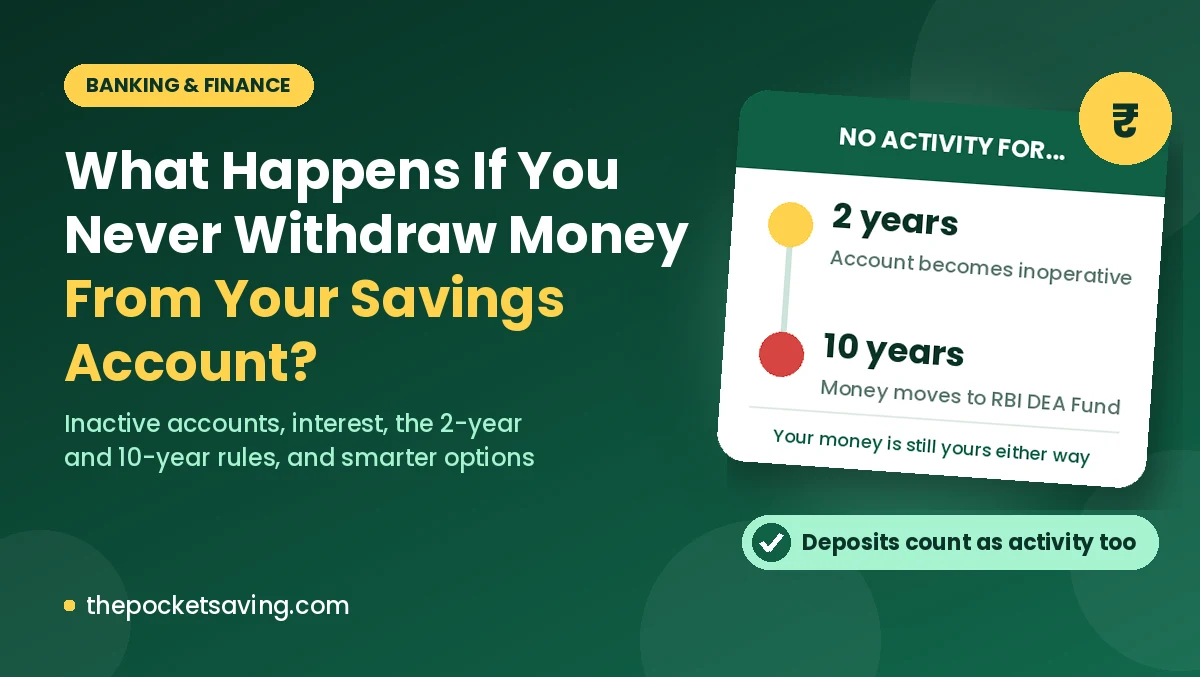
If you never withdraw, your money stays safe and keeps earning interest. Nothing bad happens as long as you use the account in some way at least once every two years. Depositing money counts, and so does a UPI payment or logging in to net banking.
The trouble starts only when there’s no activity at all, neither deposits nor withdrawals, for more than two years. Then the bank marks the account inoperative, and you can’t take money out until you reactivate it. If it stays untouched for 10 years, the balance moves to an RBI fund. It’s still yours, but getting it back takes some paperwork.
Your money keeps earning interest
The bank keeps paying interest whether you touch the account or not. RBI’s rules say savings interest must keep being credited regularly, even after an account becomes inoperative.
Most big banks pay around 2.5% to 3% a year on savings accounts right now. SBI and ICICI Bank pay 2.5%, and some small finance banks pay much more on higher balance slabs. Rates change, so check your own bank’s website for the current figure.
What counts as “using” your account
This is the part most people get wrong. RBI’s circular says an account becomes inoperative only when it has no customer-induced transactions for over two years. You don’t have to withdraw anything to keep it active. All of these count:
- Depositing cash at a branch or ATM
- Receiving or sending money by UPI, NEFT, IMPS or RTGS
- Salary, dividend, refund or government benefit (DBT) credits
- A cheque you deposit or issue
- An auto-debit or standing instruction you set up
- Logging in to net banking or mobile banking
- A balance enquiry or cheque book request through net or mobile banking
- Updating your KYC
Two things don’t count, because the bank does them, not you: the interest the bank credits, and any charges it deducts. So an account that only receives interest for two years will still become inoperative.
What happens after 2 years without activity
The bank classifies the account as inoperative. Some people call it “dormant”.
Your money is still there, and it keeps earning interest. But you can’t withdraw or transfer money from it until you reactivate it. Any UPI payment, EMI or SIP that debits that account will fail. That can mean bounce charges from your loan or mutual fund, so it’s worth checking which auto-payments use an old account.
There is some good news in RBI’s rules. Banks can’t charge you a penalty for not keeping the minimum balance in an inoperative account, and they can’t charge anything to reactivate it.
Banks also have to warn you first. RBI requires banks to review accounts with no activity for more than a year, and to tell the customer by letter, email or SMS that the account will become inoperative if nothing happens in the next year. If your registered mobile number or email is outdated, you may never see that message. That’s one more reason to keep your contact details current.
Scholarship accounts and accounts used for government benefit (DBT) payments have their own rule: banks must keep them separate so they aren’t marked inoperative, since students and beneficiaries often don’t use them for long stretches.
What happens after 10 years
If an account isn’t operated for 10 years, the bank transfers the balance to the RBI’s Depositor Education and Awareness (DEA) Fund. Banks list these unclaimed deposits on their websites, with the account holder’s name and a reference number.
The money isn’t lost. You, or your nominee or legal heirs, can still claim it from the bank, and the bank gets it back from the fund to pay you. If you’re unsure whether you or a parent has an old forgotten account, you can search across many banks at once on RBI’s UDGAM portal. We explain how families claim such money in our guide on what happens to a bank account when the account holder dies.
The hidden cost: inflation
This is the part that costs real money, and it has nothing to do with the rules.
A savings account paying 2.5% doesn’t keep up with rising prices. The RBI expects retail inflation to average about 5.2% this financial year. When prices rise faster than your interest, your money buys a little less every year, even though the balance on your screen goes up.
Here’s a rough example with ₹2 lakh left alone for a year:
| Where the money sits | Interest earned in a year |
|---|---|
| Savings account at 2.5% | ₹5,000 |
| Fixed deposit at 6.5% (example rate) | ₹13,000 |
With inflation at around 5.2%, the savings account loses roughly ₹5,400 of buying power over the year, even after the interest. The FD at least stays slightly ahead. Actual FD rates differ by bank and tenure, so treat the 6.5% as an example only.
Is it bad to keep money in a savings account?
No. A savings account is the right place for money you might need quickly. The problem is keeping much more there than you need for that.
A sensible split looks like this:
- Keep your everyday money and your emergency fund in the savings account, so you can reach it any time. For most people, an emergency fund is three to six months of expenses.
- Move money you won’t need for a year or more into a fixed deposit or recurring deposit. It earns more, and after the depositor’s death even early closure is penalty-free. If you’re comparing options, see our list of banks offering 8% or higher interest on fixed deposits.
- Ask your bank about a sweep-in or auto-sweep facility. Many banks automatically move money above a set limit into an FD and bring it back when your balance runs low. You get FD-like interest without losing easy access.
A few more things to check
Safety. Bank deposits are insured by DICGC up to ₹5 lakh per person per bank, including interest. If you keep much more than that in a single bank, think about spreading it across two or more banks.
Tax. Savings account interest is taxable as income, even though banks don’t deduct TDS on it. Under the old tax regime, you can claim a deduction on up to ₹10,000 of savings interest a year, or up to ₹50,000 of deposit interest if you’re a senior citizen. The new regime doesn’t offer this. Check with your tax advisor for your own situation.
Nominee. If your account will sit untouched for years, a nominee matters even more. Without one, your family may face a much longer process to claim it.
How to reactivate an inoperative account
If your account has already become inoperative, fixing it is simple and free:
- Visit any branch of your bank. It doesn’t have to be your home branch.
- Submit a KYC update with your Aadhaar, PAN or another officially valid document. Some banks also let you do this by video KYC.
- The bank has to process a complete request within three working days, and it will confirm the reactivation by SMS and email.
- Do one small transaction to confirm everything works, and update any auto-debits linked to the account.
For security, banks monitor reactivated accounts more closely for at least six months, and some may set temporary transaction limits. That’s normal.
Simple habits to keep your account active
- Make at least one small transaction a year, like a ₹100 UPI transfer or a small deposit
- Log in to your bank’s app every few months
- Keep your mobile number and email updated with the bank
- Add a nominee
- Close old accounts you no longer need, rather than leaving them to go dormant
FAQs
No. Banks don’t close it just because you don’t withdraw. If there’s no activity of any kind for over two years, it becomes inoperative, but the money stays in it and keeps earning interest.
Yes. Deposits, UPI payments, salary credits and even a net banking login count as activity. Only bank-made entries, like interest credits and charges, don’t count.
No. RBI’s rules require banks to keep crediting savings interest regularly on inoperative accounts too.
No. RBI doesn’t allow penal charges for minimum balance in inoperative accounts, and reactivation is free.
It moves to the RBI’s DEA Fund. You can still claim it from your bank at any time, and you can search for it on the UDGAM portal.
Keep what you may need quickly in a savings account. Money you won’t need for a year or more usually earns more in an FD or RD.
You can read RBI’s full rules in its Master Circular on Inoperative Accounts and Unclaimed Deposits (January 1, 2024), and the deposit insurance rules on the DICGC website.
This article is for general information only and is not financial or tax advice.