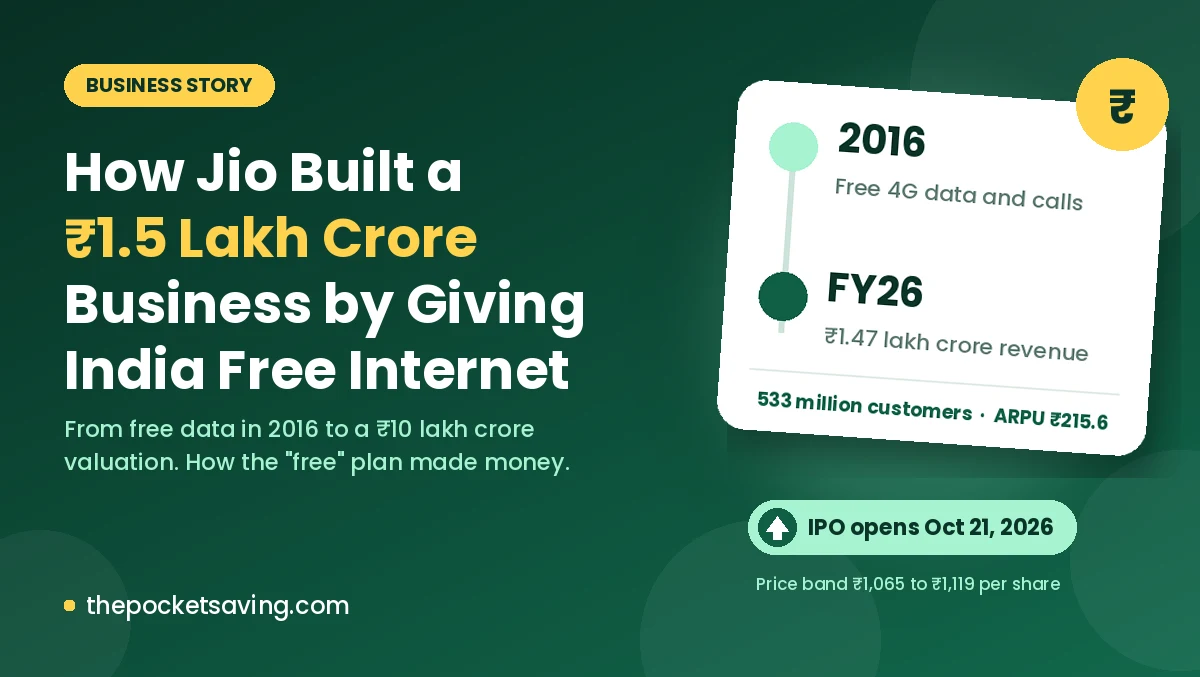
In September 2016, a company most Indians had never heard of offered them something that sounded too good to be true: free 4G data and free calls, with no catch you could see.
Ten years later, that company earns nearly ₹1.5 lakh crore a year. Its IPO opens today, at a valuation of around ₹10 lakh crore. And the free internet that started it all is long gone.
So how do you build one of India’s most valuable businesses by giving your product away? The short answer is that Jio was never really selling data. It was buying customers.
The free offer that changed everything
Jio launched to the public on September 5, 2016. Data and calls were free under its Welcome Offer, which was then stretched into a Happy New Year Offer. Paid plans only started on April 1, 2017.
People didn’t need much convincing. Jio said it reached 100 million customers in just 170 days, adding about 7 customers every second. Queues outside phone shops for Jio SIMs became a normal sight in Indian cities that winter.
Data prices fell off a cliff. India’s average mobile data price was about ₹226 per GB in 2015, according to figures compiled by fact-checker BOOM. By 2018 it was under ₹12. Rivals had to cut prices to survive, and several couldn’t. Over the next few years, the market shrank to three big private players.
Why giving it away made sense
Free sounds like a terrible business plan. For Jio, it was a calculated one, for three reasons.
Telecom is a game of scale. Building a nationwide 4G network costs a fortune whether you have 10 million customers or 400 million. Once the towers and fibre are in place, each extra customer costs very little. The faster Jio filled its network, the faster that huge fixed cost was spread thin.
Switching costs are real. Once your number, your bank OTPs and your WhatsApp are all on a Jio SIM, you rarely move. Free data got people in the door, and habit kept them there.
Data was just the start. A customer who uses 40 GB a month is a customer you can sell broadband, entertainment and payments to. Jio’s real bet was on what people would do with all that data.
Then came the price hikes
The free phase lasted about seven months. After that, Jio charged for its plans, though still at prices well below what Indians were used to.
Over time, prices crept up. Jio and its rivals raised tariffs in several rounds after late 2019, and that’s where the money started to show. The figure to watch is ARPU, or average revenue per user: how much Jio earns from each customer each month.
| FY24 | FY26 | Q1 FY27 | |
|---|---|---|---|
| ARPU (per user per month) | ₹181.7 | ₹214 | ₹215.6 |
| Customers | 482 million | 524 million | 533 million |
When you have over 50 crore customers, a few rupees more per person adds up very quickly. Each extra rupee of ARPU across 533 million customers is worth about ₹640 crore a year.
The numbers today
Here’s what Jio Platforms looks like now, from its IPO filings:
| FY25 | FY26 | |
|---|---|---|
| Revenue | ₹1,28,218 crore | ₹1,46,885 crore |
| Net profit | about ₹26,100 crore | about ₹30,000 crore |
Customers aren’t just using more, they’re using a lot more. Average data use was 43.7 GB per user per month in the June 2026 quarter, up from 37 GB a year earlier. Jio had 285 million 5G customers and 28.6 million home broadband subscribers, including 14 million on JioAirFiber.
That’s the payoff from 2016. The free data built the habit, and the habit became the business.
The big money behind it
Building all this took enormous investment. In 2020, in the middle of the pandemic, Jio Platforms raised ₹1,52,056 crore by selling about 33% of the company to investors. These included Facebook (now Meta), which bought 9.99%, and Google, which bought 7.73%. Private equity firms and sovereign funds took most of the rest.
That money helped Reliance cut its debt and gave Jio room to keep spending on its network, including the expensive move to 5G.
The Jio IPO: what’s on the table
Jio Platforms’ IPO is open from today, October 21, to October 23, 2026.
- Price band: ₹1,065 to ₹1,119 per share
- Issue size: about ₹30,000 crore, all new shares
- Use of the money: about ₹27,500 crore to repay or prepay debt
- Implied valuation: about ₹10.3 lakh crore
Analysts are watching a few things: whether Jio can keep raising ARPU without losing customers, how much more it has to spend on its network, and how depreciation and spectrum payments weigh on profit. Centrum Broking expects a tariff hike of about 12% within the next few months. That’s a forecast, not an announcement, but it’s worth knowing if you’re on a Jio plan.
If you’re thinking about applying, you’ll need a Demat account. Before deciding, it helps to read the company’s numbers the way an investor would. Our guides on how to understand a company before investing and the important financial numbers you must know are a good place to start.
What Jio’s story teaches about money
Jio’s strategy is a business lesson, but it’s also a reminder for anyone with a phone bill.
“Free” is usually a customer-acquisition cost. Someone pays eventually. With Jio, it was investors at first, and customers later through higher tariffs. The same logic sits behind free trials, zero-fee credit cards and “no-cost” EMIs.
Small increases add up. A ₹20 rise in your monthly plan doesn’t feel like much. Over a year, that’s ₹240. Across a family of four on separate plans, it’s close to ₹1,000. It’s worth checking your plan once a year to make sure you’re not paying for data you never use.
Habits are worth a lot of money. Jio spent heavily to make itself part of your daily routine. When you spend, ask whether you’re choosing the product or just following a habit.
The bottom line
Jio didn’t really give India free internet. It paid for India’s attention up front, built the habit of cheap data, and then slowly charged for it. Ten years later, that bet is worth about ₹10 lakh crore.
Whatever you think of the IPO, it’s hard not to admire how patient the plan was.
You can read Jio’s original 2017 announcement in Reliance’s 100-million-customer media release. For the IPO details, see Business Today’s report on the Jio IPO.