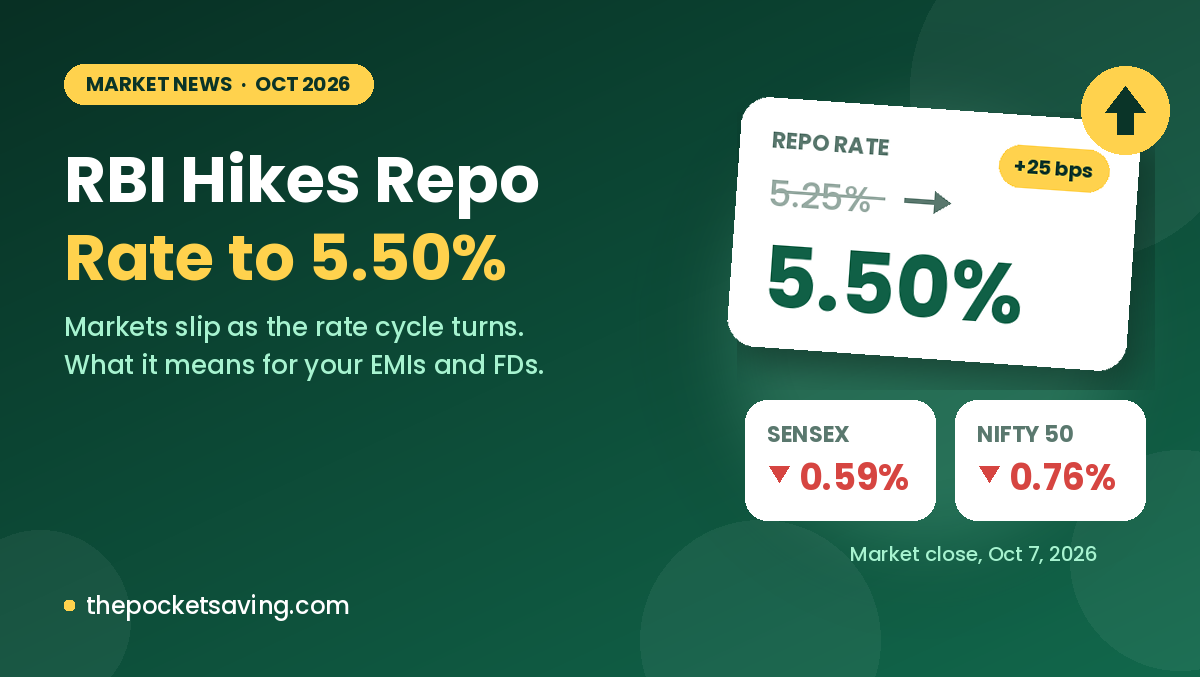
The Reserve Bank of India raised its repo rate by 25 basis points to 5.50% on Wednesday, October 7. It’s the first hike since February 2023, and it ends a stretch in which rates were either cut or left alone.
The six-member Monetary Policy Committee voted unanimously for the hike. The bigger signal was the change in stance, from “neutral” to “calibrated tightening”. That part passed by a 4-2 majority, and it tells you the RBI is more likely to raise rates again than to cut them.
Why the RBI raised rates
The short answer is inflation.
The RBI raised its CPI inflation forecast for FY27 by 20 bps to 5.2%, and its core inflation projection to 4.4%. It expects inflation of 4.9% in the July–September quarter, 6% in October–December, and 5.7% in January–March. A 6% reading would put inflation right at the top of the RBI’s tolerance band.
Crude oil isn’t helping. Brent was back above $101 a barrel on the day of the decision, and analysts also pointed to rising global bond yields and continued selling by foreign investors.
The growth picture, oddly, got better. The RBI raised its FY27 GDP growth forecast by 40 bps to 7.1%, citing momentum in services, strong capacity utilisation and robust credit flows. That’s what gives the central bank room to fight inflation without worrying too much about choking growth.
How the markets reacted
Stocks fell, but not dramatically.
The Sensex dropped 429.11 points, or 0.59%, to close at 72,638.70. The Nifty fell 173.05 points, or 0.76%, to 22,603.05. Markets had tried to recover after a weak open, but the bounce didn’t last.
The hike itself was expected. What unsettled investors was the change in stance. Vinod Nair of Geojit Investments said the market “reacted more sharply to the shift in policy stance from neutral to calibrated tightening, which signals a turn in the rate cycle.”
Here’s how sectors moved:
- Biggest losers: metal, followed by realty, auto, IT and consumer stocks
- Gainers: PSU banks and media ended slightly higher
- Broader market: Nifty Midcap100 fell 0.63%, while Nifty Smallcap100 actually rose 0.30%
Banks held up because higher rates usually mean better lending margins for them. Realty and auto fell because they depend on people taking loans, and loans just got a bit more expensive.
The rupee had a tougher day. It came close to a record low at 96.84 against the dollar, although Governor Sanjay Malhotra said he thinks the currency may be undervalued.
Is another hike coming?
Probably, if inflation behaves the way forecasters expect.
SBI Research now expects the repo rate to reach 6% by December. It estimates CPI inflation could peak around 6.8% in November 2026. It also thinks the December meeting could bring a bigger 50 bps hike, depending on global conditions. SBI Research summed up the new policy as a move “from watchfulness to explicit tightening,” not a panic response.
That’s one forecast, not a certainty. But with the stance now set to tightening, a rate cut is off the table for now.
What this means for your money
Home loan EMIs will go up a little. If your loan is linked to the repo rate (most new floating-rate home loans are), your interest rate should rise by about 0.25% at the next reset date. Here’s a rough idea, assuming a 20-year loan moving from 8.00% to 8.25%:
| Loan amount | Old EMI | New EMI | Extra per month |
|---|---|---|---|
| ₹30 lakh | ₹25,093 | ₹25,562 | ₹469 |
| ₹50 lakh | ₹41,822 | ₹42,603 | ₹781 |
Some banks keep the EMI the same and extend the tenure instead. Check which one your bank does, because a longer tenure costs you more interest overall.
FD rates may rise. Banks often raise deposit rates after a repo hike, though usually more slowly than they raise loan rates. If you’re planning a new FD, it may be worth waiting a few weeks to see how rates move, or splitting your money into smaller FDs booked at different times. Our list of banks offering 8% or higher interest on fixed deposits is a good place to compare.
Stock investors should expect bumpy weeks. Rate hikes, expensive crude and foreign selling together make for a nervous market. If you invest for the long term, one policy decision shouldn’t change your plan. If you’re new to this, our guide on how the Indian stock market works explains the basics.
Keep your safety net in place. When EMIs and prices are both rising, a healthy emergency fund is what stops a tight month from turning into debt.
What to watch next
- Q2 earnings season, which starts this week. Investors want to see whether companies can handle higher input costs.
- The US Federal Reserve’s next meeting, which will affect the rupee and foreign investor flows.
- October and November inflation data, which will decide what the RBI does in December.
- The next MPC meeting, from December 2 to 4, 2026.
For the full policy statement, see the RBI’s monetary policy page. For SBI Research’s rate outlook, see Business Today’s report.