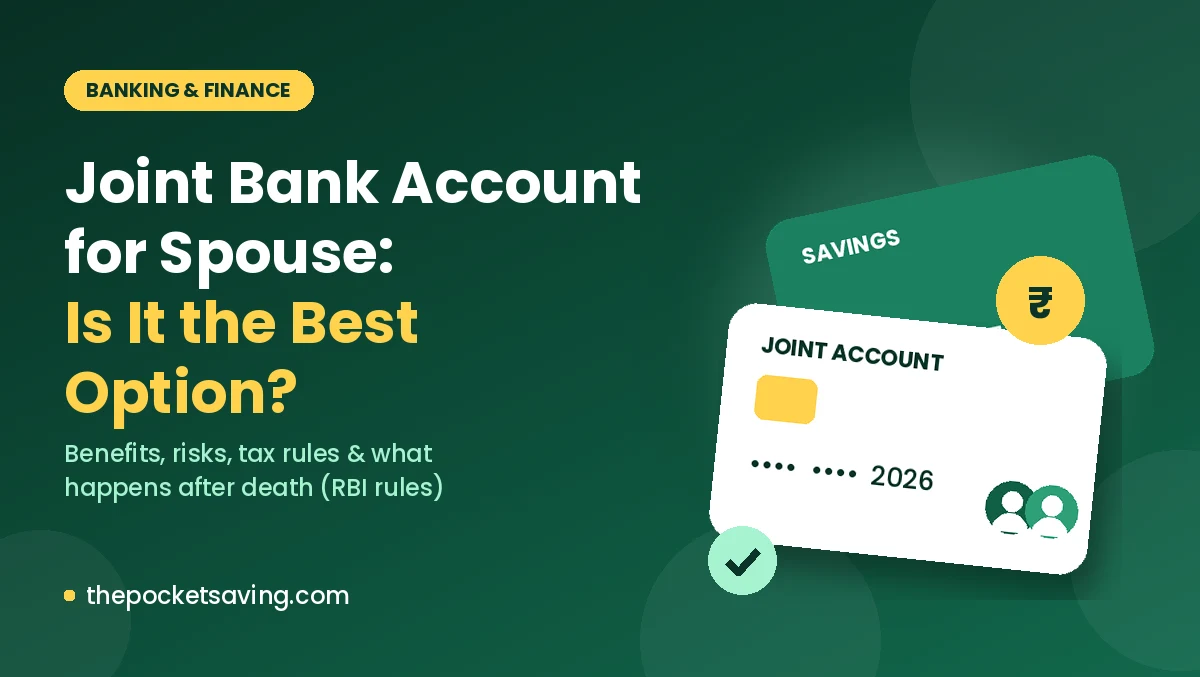
A joint bank account for spouse or family use sounds like the obvious choice. You’re sharing a home and bills, so why not share an account?
For many couples it does work well. But a joint account is a tool, and it’s good at some jobs and bad at others. It makes household spending easier and helps a lot when one partner dies. It also means either person can empty the account without asking, and it can create tax confusion if nobody thinks it through.
Most families don’t need to choose between “everything joint” and “everything separate.” The setup that works best for most people is somewhere in between. Let’s go through how joint accounts actually work in India, so you can decide what fits your family.
What is a joint bank account?
A joint bank account is a savings, current or fixed deposit account held by two or more people. Husband and wife is the most common pair, but you can also open one with a parent, child, sibling, or another family member.
The part most people skip when opening the account is actually the most important: the operating instruction, also called the mode of operation or mandate. It decides who can withdraw money while everyone is alive, and who gets it after someone dies.
Types of joint accounts: Either or Survivor, Former or Survivor and more
RBI allows banks to open joint accounts on terms such as Either or Survivor, Former/Latter or Survivor, and Anyone or Survivors. Here’s what each one means in practice.
Either or Survivor. Either holder can operate the account alone: withdraw money, write cheques, use the debit card. If one dies, the other carries on. This is the most common type for couples. The convenience is also the risk, because either holder can legally move the entire balance without the other.
Former or Survivor. Only the first-named holder can operate the account during their lifetime. The second holder gets access only after the first holder dies. Pensioners and senior citizens use this a lot. The parent keeps full control for life, and the transfer to the child afterwards is smooth.
Latter or Survivor. This is the reverse of Former or Survivor. Only the second-named holder can operate the account, and the first-named holder gets access only after the second dies.
Jointly or Survivor. Both holders must sign every transaction while alive. It’s the most secure option, but also the least practical for daily use.
Anyone or Survivor(s). This is for accounts with three or more holders. Any one of them can operate it.
A quick tip: if you’re not sure which mode your existing account uses, look at the passbook’s first page or the account details in your net banking. It’s usually written there.

Benefits of a joint bank account for husband and wife
Household spending gets simpler. Rent, groceries, school fees, electricity bills, and EMIs can all go out of one account. Both partners can see what’s coming in and going out, which helps a lot if you follow a monthly budget together.
Money stays accessible in an emergency. If one partner is in hospital or travelling, the other can still pay bills without needing a power of attorney.
It makes things much easier after a death. This is the biggest practical reason. In an account with a survivorship clause, payment to the survivor is a valid discharge of the bank’s liability, as long as the bank has confirmed the survivor’s identity and the death with proper documents. In simple terms, the surviving spouse shows the death certificate and keeps using the account. There’s no waiting for a legal heir certificate while bills pile up. We explain the full process in our guide on what happens to a bank account after the account holder dies.
It builds transparency. Some couples like how a shared account makes money a shared conversation rather than something one person handles quietly.
You may get extra deposit insurance. More on this below. It’s a small but useful benefit for families with larger savings in one bank.
Disadvantages of a joint account you should know
Either holder can withdraw everything. In an Either or Survivor account, the bank will honour a withdrawal from either person. If the relationship breaks down, the bank won’t step in to protect “your share.”
Adding someone is easy. Removing them usually isn’t. Most banks need both holders to agree before a name is removed. If one person refuses, you may have to close the account and start again.
One person’s problems can reach the account. If one holder has a legal dispute, an unpaid debt, or a tax issue, the whole joint account can get frozen while things are sorted out. The other holder then has to prove which money is theirs.
Survivorship is not the same as inheritance. Under RBI’s current rules, a survivor who receives the balance holds it as a trustee for the deceased holder’s legal heirs. If your will says your savings should go equally to your spouse and children, putting your spouse on the account doesn’t override that. The survivor gets access, and the will or succession law still decides ownership.
Tax isn’t automatically split. This catches many couples out, so we’ll cover it in its own section.
Who pays tax on interest in a joint bank account?
The bank usually treats the first-named holder as the owner for tax purposes. If a fixed deposit linked to the account earns more than the TDS limit, TDS is deducted in the name of the primary account holder.
For tax, what matters is whose money it is, not whose name comes first. If the money came from the husband’s salary, the interest is his income, even if the wife is listed first.
There’s also a clubbing rule for spouses. If one spouse gives money to the other without adequate consideration, meaning as a gift rather than a loan or payment, and the other invests it, the income from it is taxed in the giver’s hands. The exception is money the spouse earned themselves, such as their own salary or business income, or assets bought from their own independent funds. That income isn’t clubbed.
What this means for you:
- If only one spouse earns, keep that spouse as the first holder on FDs so the TDS and the income line up with the same person.
- If both earn and contribute, keep a rough record of who put in what. It makes tax filing much cleaner.
- If you’re unsure, ask your CA to check before you move large amounts into joint FDs.
Deposit insurance: a hidden benefit of joint accounts
Every bank deposit in India is insured by the DICGC up to ₹5 lakh per depositor per bank. That limit covers principal and interest together. The government has been considering an increase, but it hasn’t happened yet, so plan around ₹5 lakh until it officially changes.
Here’s where joint accounts help. According to the DICGC’s FAQ, multiple joint accounts where the names are in the same order are counted together. But if the names are in a different order (A-B versus B-A), or the group of people is different, each account gets separate cover up to ₹5 lakh.
So a couple could hold separate insurance cover through:
- Husband’s individual account
- Wife’s individual account
- Joint account: Husband first, Wife second
- Joint account: Wife first, Husband second
One small bank lists this example directly: two adults holding four accounts in different capacities (A, B, AB and BA) get up to ₹20 lakh of effective cover.
This matters most if you keep large FDs at a single small finance bank or co-operative bank for the higher rates. If you’re comparing options like the ones in our list of banks offering 8% or higher interest on fixed deposits, structure your FDs this way so more of your money is insured.
Joint FDs: one rule you should know now
Joint fixed deposits have a catch that most people only discover after a death. If one holder dies, breaking a joint FD early normally needs consent from the surviving holders and the legal heirs of the deceased holder.
The fix is simple. With a survivorship clause, all depositors can give the bank a joint mandate for premature withdrawal, either when opening the FD or later. Once that mandate is on file, the survivor can close the FD early without chasing the heirs for signatures.
Ask your bank for this mandate the next time you open or renew a joint FD. It takes one form.
You can read the original rule in RBI’s circular on repayment of joint term deposits.
Joint account with parents or senior citizens
Adding a son or daughter to a parent’s account is very common, especially for pension accounts. Former or Survivor usually works best here: the parent stays in control during their lifetime, and the child can step in afterwards without paperwork delays.
Be more careful with Either or Survivor for elderly parents. It lets the child withdraw freely today, which is convenient if the parent needs help, but it also leaves the parent with no protection if there’s a family disagreement or misuse. Choose the mode based on how much day-to-day help the parent actually needs.
Joint account with an NRI family member
If a family member lives abroad, RBI allows it. Banks can add a non-resident close relative to a resident’s account as a joint holder on an Either or Survivor basis, subject to some conditions. This covers all types of resident accounts, including savings accounts.
If the NRI ends up as the survivor, the account is converted into an NRO account under the current regulations. Keep that in mind if you’re planning for parents in India with children abroad.
Joint account vs nominee vs separate accounts
Here’s the practical difference between the three setups:
| Question | Joint account | Individual account + nominee | Separate accounts only |
|---|---|---|---|
| Can the partner use the money while you’re alive? | Yes (depends on mode) | No | No |
| How easy is it after death? | Very easy for the survivor | Easy (3 documents) | Harder without a nominee |
| Can one person withdraw without the other? | Yes, in Either or Survivor | No | No |
| Privacy | Low | High | High |
| Extra DICGC cover | Yes, if names are in a different order | No | No |
A nominee and a joint account are not substitutes. They solve different problems, and a joint account can have a nominee too. In a joint account, the nominee’s right only arises after all the account holders have died. That’s why you should add a nominee to your joint accounts as well. Banks now let you name up to four.
The best setup for most couples: “Yours, mine and ours”
The system that works for most families is three accounts:
One joint account (Either or Survivor) for shared expenses. Both partners send a fixed amount to it each month, and all household bills go out from here. Keep your family emergency fund in this account or in a joint FD, so whoever needs it can reach it.
One individual account each for personal spending and personal savings. Both partners get some financial independence, and nobody has to explain every small purchase.
Nominees on everything, including the joint account.
This gives you the convenience of shared money without either partner giving up control of everything. It also keeps the tax picture cleaner, because each person’s own savings stay in their own name.
If you’re working on a bigger shared goal, like early retirement, the joint account is also a good place to track your combined progress. We explain how to set that target in our guide to calculating your FIRE number.
Checklist before opening a joint bank account
- Pick the operating mode deliberately. Don’t just tick the default box.
- Decide who goes first. This affects TDS, and it’s best if it’s the person whose money it mainly is.
- Add one or more nominees.
- For joint FDs, sign the premature withdrawal mandate.
- If you keep more than ₹5 lakh in one bank, reverse the name order across accounts to get separate insurance cover.
- Talk openly about how much each person will put in and what the account is for.
FAQs
Yes, for shared household expenses and emergencies it’s very practical. It works best alongside individual accounts rather than as your only account.
In an Either or Survivor account, yes. The bank will process a withdrawal from either holder. If you want both signatures on every transaction, choose Jointly or Survivor.
If the account has a survivorship clause, the survivor continues to operate it after giving the bank the death certificate. The survivor receives the money as a trustee for the deceased’s legal heirs, so the will or succession law still decides ownership.
No. A savings account is not a credit product and doesn’t show up on your credit report. Joint loans and joint credit cards are different, because missed payments affect everyone on them.
Usually only with the consent of all holders. If that’s not possible, the usual route is to close the account and open a new one, which also needs both signatures in most cases.
The person whose money was deposited. The bank deducts TDS in the first holder’s name, so it’s easiest if that’s also the person who funded the FD.
Yes. The nominee’s right only comes into play after all joint holders have died. Without one, your children or other heirs would have to go through the full legal heir process.
Most banks allow joint accounts between family members and even non-relatives. The same risks apply: either person may be able to withdraw everything, and removing a name later can be difficult.